Automatic feeders make a real difference to households with long or irregular working days, and they cause a specific kind of problem when the wrong type is bought. The categories look similar on a shelf and are not interchangeable.
The three types
Gravity feeders
A hopper that refills a bowl as it empties. No electronics, nothing to fail, and no portion control at all — the animal eats as much as it wants. Suitable only for pets that self-regulate, which most cats do not and most dogs certainly do not.
Timed dry-food dispensers
The mainstream option. A motor releases a set portion at set times. Good portion control, useful for weight management, and the type most people should be looking at.
Cooled wet-food feeders
Sealed compartments, usually with an ice pack or active cooling, opening on a timer. These exist because wet food spoils quickly at room temperature. A dry dispenser cannot be used for wet food, and this is the single most common purchasing mistake in the category.
Our cat feeders and fountains listings state clearly which food type each model handles.
What to check before ordering
Power and backup
Mains power with battery backup is the combination you want. Battery-only units run down at inconvenient moments; mains-only units miss meals in a power cut.
Capacity against absence
Work out the total food required for the longest period the feeder will cover, then add a margin. A hopper that is exactly enough leaves no room for error.
Jam behaviour
Every dispenser can jam, and the important question is what happens next. Better units detect a jam, retry, and alert. Cheaper ones keep running and dispense nothing.
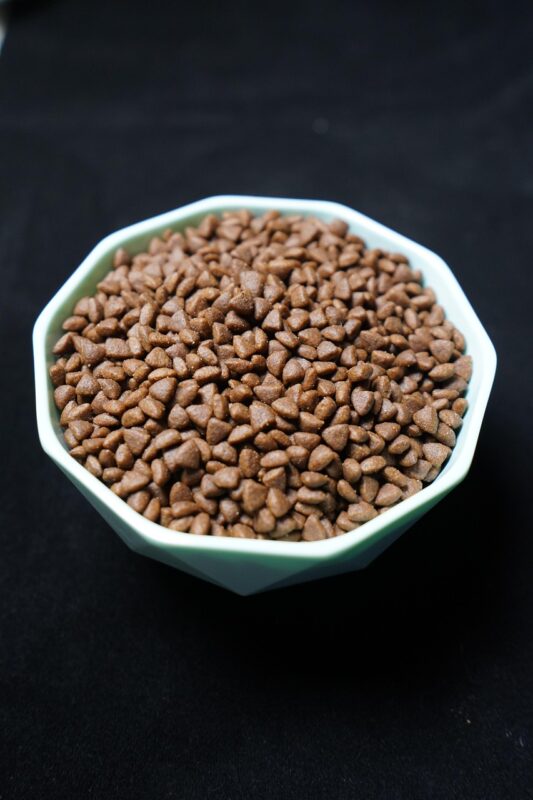
Kibble shape matters here more than people expect: large, irregular or flat kibble jams far more readily than small round pieces. If you change food, recalibrate and watch the first few cycles.
Cleaning
Whatever holds food must come apart and be washable. Fixed hoppers accumulate fat residue and go rancid, which puts animals off eating and is unpleasant to deal with.
Pet-proofing
Some animals are determined engineers. Look for a locking lid and enough weight that the unit cannot be tipped. A dog that empties a hopper in one sitting is a veterinary emergency risk, particularly with bloat-prone breeds.
Multi-pet households
Timed feeders do not solve competition. In a house with more than one animal, the fastest eater takes whatever is dispensed, and any medical or weight-management diet becomes impossible to enforce.
Microchip or RFID feeders open only for a registered animal and are the correct answer here. They cost more, and they are the only thing that works.
Testing before you rely on it
- Set it up and run it for a week while you are home.
- Weigh the dispensed portions on several occasions — actual output frequently differs from the setting.
- Watch the animal use it; some are frightened by the motor noise and need it introduced gradually.
- Test the battery backup by unplugging it for a cycle.
- Only then use it for an absence.
Introducing it to a nervous animal
Place the feeder next to the existing bowl, switched off, for a few days. Then run it while you are present and feeding normally. Cats in particular can be startled by the dispensing sound and will avoid the machine entirely if the first experience is a surprise.
What a feeder does not replace
It manages timing and portions. It does not tell you whether an animal is eating, drinking, using the litter box or behaving normally. Any absence longer than a day still needs someone visiting daily, and connected feeders with a camera should be treated as a convenience rather than a substitute.
Water
Cats frequently drink too little, and many prefer moving water. A fountain often increases intake meaningfully, which matters for urinary health. Filters need changing on schedule and the pump needs descaling, so factor that into the routine rather than treating it as fit-and-forget.
Fountains and feeders are listed together under cat feeders and fountains, with capacity and filter type on each listing. If you are unsure which type suits your household, describe the setup and we will tell you what we would use. The FAQ covers common questions and everything else is on the shop page.
From our shelves
Products in this store that relate to what is covered above:
Prices are in US dollars. Delivery timings are on our shipping policy page and the return and refund policy sets out the window if something is not right.
Key points
- Dry-food dispensers and cooled wet-food feeders are different machines; only buy a wet-food model if the listing says so explicitly.
- Test any feeder for a week while you are home before relying on it. Portion drift and jams show up in normal use.
- Prefer feeders with battery backup, so a power cut does not mean a missed meal.
- Kibble shape and size affect dispensing accuracy far more than people expect — recalibrate whenever you change food.
- Multi-cat households usually need microchip or RFID feeders rather than timed ones, or the fastest cat eats everything.
- A feeder is not a substitute for supervision: never leave an animal on automatic feeding without someone checking daily.
Related reading